What changes when powered walking support leaves the product demo and meets heat, sand, distance and a real working day.
Field note
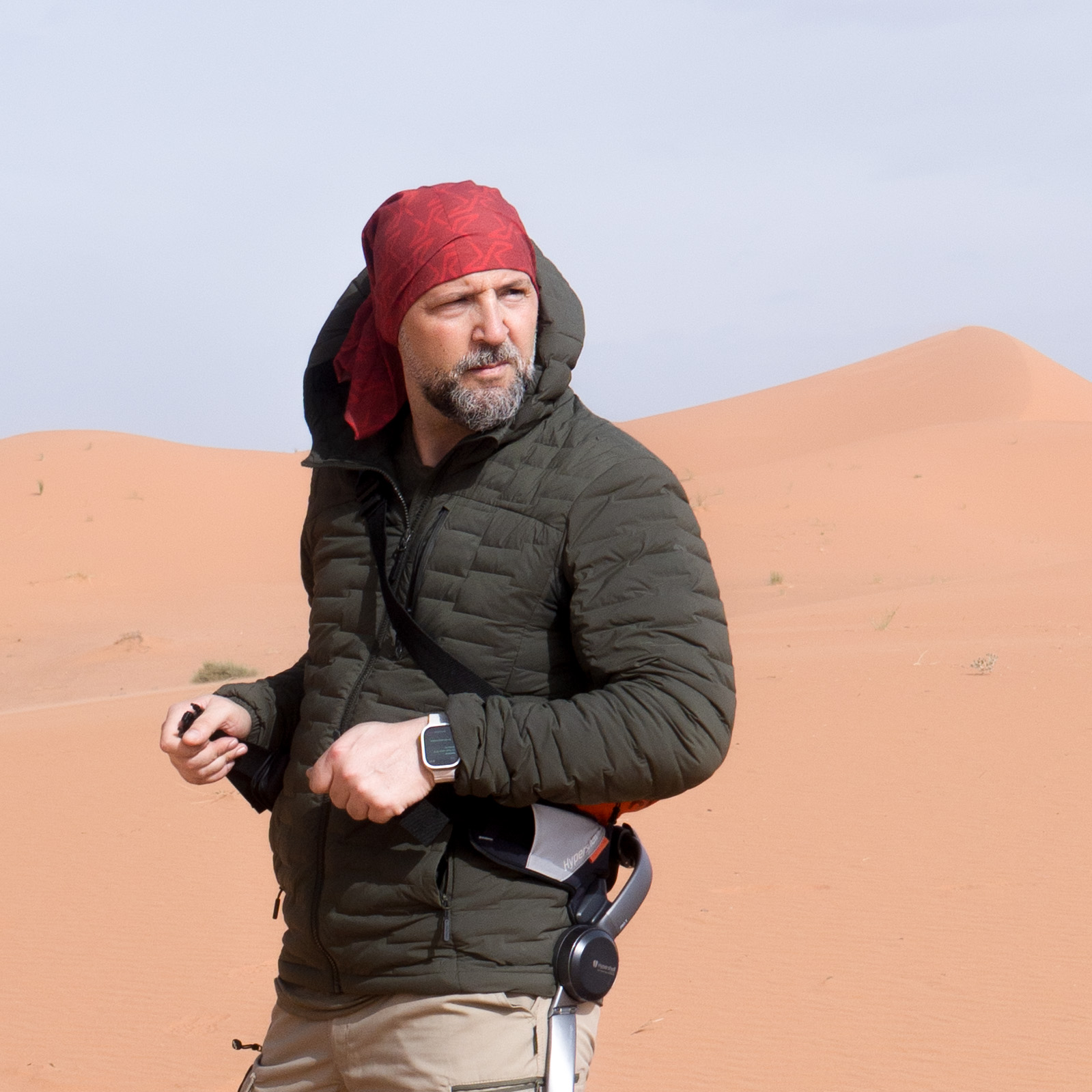
This started with one concrete field case: a Hypershell X worn across the Sahara. I was brought in because I know how products behave when the environment stops being cooperative. The Sahara gave the system heat, dust, loose sand, dunes and long days. Hypershell performed better than I expected. The larger question is what this kind of test can teach us about exoskeletons as a category.
47 km walked7 days35°C8 hours in eco mode01
The real question
A powered exoskeleton is easy to understand in a clean product demonstration. The harder question is whether it still contributes when every variable gets worse at the same time: heat, dust, soft ground, changing gradients, a heavy pack and a day that does not end after the camera stops.
02
What the field made visible
Across 47 km and 7 days, the useful signal was not a dramatic peak performance moment. It was consistency. The system stayed relevant when the terrain demanded more work and the body had to keep making decisions. In eco mode, the battery supported up to 8 hours in the conditions documented for this project.
03
Why the result matters
The Sahara test moved the product out of the category of interesting technology and into a more useful category: equipment with a job. Assistance only matters when it carries its weight beyond the studio. Here, the device helped make long, uneven movement more manageable without pretending to remove the environment from the equation.
04
The friction stays in the story
Loose sand, heat and dust do not disappear because a product has a strong specification sheet. Fit, balance, charging, maintenance and the way the system responds to changing ground all become part of the work. That is not a reason to dismiss the technology. It is the information a serious field decision needs.
05
What this does not prove
One expedition is not a universal performance guarantee. It does not turn an outdoor exoskeleton into medical equipment, and it does not tell every person whether the product belongs in their kit. It shows something narrower and more useful: this system was able to contribute in a demanding real-world environment, and it deserved a closer look after the cameras stopped.
A useful field method
How to read an outdoor technology test
1. Start with the environment
Heat, dust, sand and gradients are not background scenery. They are the test conditions. A product that only works when the setting is controlled has not yet earned a field claim.
2. Track the whole day
Battery figures and motor power are only meaningful next to distance, duration, surface and the decisions a person still has to make. The practical unit is not the specification. It is a day of work.
3. Separate help from hype
The right question is not whether the device looks impressive. It is whether the assistance is still useful after weight, heat, dust and repetition have entered the equation.
The useful part
What stays after the test
Outdoor technology should be evaluated where the environment can interrupt the product story.
The Hypershell system did not fail in the Sahara. It performed better than expected in a demanding field context.
The valuable result was sustained usefulness, not a single spectacular specification.
A credible field review includes fit, friction, charging, maintenance and limits, not only the successful moments.
Source note. Editorial basis: field notes and the reviewed Hypershell X product research assembled on 21.07.2026. Product figures are time-bound and are included as context, not as a current offer or performance promise.
Exoskeleton field guide
The category is bigger than one product.
This page is for the decision before the purchase question: where could assistance help, what might it move somewhere else and which evidence is still missing?
Start here
Four checks before the brand comparison.
01
Start with the task
Which movement loads which part of the body, how often and under which conditions? An exoskeleton does not support abstract “work”.
02
Check the alternatives
Technical and organisational measures come before a person-bound solution. An exoskeleton is not automatically the first lever.
03
Balance relief against friction
Relief is not the only deciding factor. Fit, heat, freedom of movement, transitions, cleaning and the learning curve decide whether people will use it.
04
Field test before brochure
Before continuous use, run a supported trial with subjective feedback and objective checks in the actual workplace.
Guided learning layer
What do you want to understand first?
Choose a question. The answer stays in this browser. No profile, prompt or personal data is sent anywhere.
Answer layer
Understand the mechanism
An exoskeleton does not make a person stronger in the abstract. It adds a mechanical contribution at a defined joint or movement pattern. The useful question is where that contribution appears, when it appears and what the person still has to do.
01 · Origin
The idea is older than the hype.
The first powered exoskeletons were not built for weekend adventures. GE’s Hardiman programme ran from 1965 to 1971 and aimed to amplify human strength. The machine weighed around 680 kg and never left the laboratory. That gap matters. A concept can be technically impressive and still be unusable in the place where a person actually has to move.
02 · The shift
The interesting change is not the word AI.
Consumer outdoor exoskeletons only became a real product category around 2024. The shift is from a laboratory machine to a wearable system that has to fit a person, manage energy and react to movement without taking the whole task away. Sensors, control logic and motor response matter here, but only because they change what happens under the feet.
03 · The field case
The Sahara is a useful filter.
Heat, loose sand, dunes, dust and long walking days remove the clean edges from a product story. They expose fit, balance, battery behaviour, control response and maintenance at the same time. That is why the Hypershell case belongs here. It gives the category a real environment to answer to, instead of leaving the discussion at the level of rendered product images.
04 · The decision
Start with the movement, not the manufacturer.
A walking-assist system, an ankle push-off device and an industrial lifting exoskeleton do not solve the same problem. A useful comparison begins with the movement you want to support, the environment it must survive, the weight you are willing to carry and the amount of control you want to keep. The provider comes after that decision.
05 · The field method
A credible test follows the whole day.
The strongest outdoor test is not a dramatic clip of one steep section. It follows the preparation, the first fit, the ordinary kilometres, the awkward transitions and the point where attention starts to run low. Record what the system changes in the body, but also what it asks in return: charging, adjustment, cleaning, carrying and learning a new rhythm of movement.
06 · The useful boundary
One field result can be valuable without becoming a promise.
The Sahara case does not prove that every wearer will experience the same result, or that a powered system is suitable for medical, occupational or safety-critical use. It proves something narrower and more useful: a category-level question can be tested when the environment is allowed to interrupt the product story. That boundary is what keeps an editorial field guide honest.
The comparison before the comparison
Six questions that stop a spec sheet from making the decision.
Movement
Which joint or movement pattern receives assistance?
Environment
Where must it work: trail, dune, factory, rehabilitation or lab?
Energy
How long does the system need to remain useful before charging or adjustment?
Control
Does it respond to the wearer, or does the wearer have to adapt to it?
Friction
What happens with heat, dust, fit, maintenance and repeated use?
Evidence
Which claims are measured, which are reported and which are still marketing?
Provider landscape
Different machines. Different jobs.
Snapshot checked 21.07.2026. The entries are editorial references, not rankings, endorsements or purchase advice.
Independent editorial comparison. Provider names identify the products discussed. No affiliation, sponsorship or endorsement is implied. Logos and provider imagery are excluded until their usage rights are documented.
The next useful step
From field test to working proof.
Compare this project with the current systems or start a direct conversation about a concrete collaboration.